How to choose the right twist drill bit for wood
When choosing a twist drill bit for wood, focus mainly on the type of work, the material, and how often you will use it.
By workload and material
For occasional drilling in soft or medium-hard wood, standard rolled drill bits made of chrome-vanadium steel are sufficient.
If you drill more often, want a cleaner hole, or work with harder wood, choose ground HSS drill bits.
For very hard or abrasive materials (for example exotic wood species), drill bits with a carbide tip are more suitable because they offer higher wear resistance.
By the required hole accuracy
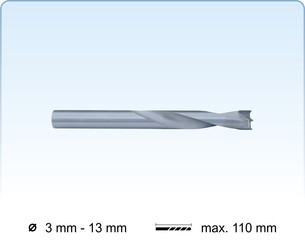
For standard technical pilot holes for screws, a twist drill bit is an ideal choice. However, if you need a perfectly flat-bottomed hole (for example for hinges), a twist drill bit is not suitable and you need to choose a Forstner bit.
How to recognize a twist drill bit for wood
A classic twist drill bit for wood has a pronounced center point that guides the bit when you start drilling and prevents it from slipping on the surface. On the sides, there are often scoring spurs that first cut the wood fibers, and only then does the main cutting edge remove material.
Unlike a metal drill bit, a typical wood drill bit does not have a flat tip with a point angle without a center point. A metal drill bit “bites” into wood less easily and can slip on the surface, especially in harder or smoother materials.
When choosing, always make sure you are selecting a drill bit designed specifically for wood – you can recognize it by the center point and the cutting geometry adapted to fibrous material.
Where twist drill bits are used in practice
Twist drill bits are a universal solution for everyday woodworking – from small installations to batch production.
Typical examples of use:
- pre-drilling holes for screws when assembling furniture or solid-wood structures,
- drilling holes for dowel joints in furniture production,
- preparing holes for electrical installation in sheet materials,
- drilling in OSB boards, plywood, or laminate during interior installation work,
- standard service work in a workshop or on site.
They are used mainly where a standard hole of a small to medium diameter is required and where it is not necessary to drill deep into solid beams (for those purposes, auger bits are more suitable).
For precise flat-bottomed holes (for example for hinges), twist drill bits are not suitable – in that case, the right choice is a Forstner bit.
How to work with twist drill bits
Use twist drill bits for wood in drills without hammer action – handheld drills, drill presses, and cordless drills.
Follow these guidelines when working:
Drill without hammer action
Always drill without hammer action. Hammer action is intended for concrete and masonry and would damage both the material and the tool when drilling into wood.
Set the correct speed
Adjust the speed to the drill bit diameter – the larger the diameter, the lower the speed. It is better to start at a lower speed and increase it slightly depending on how the material behaves. You can tell you have the correct setting when the bit cuts smoothly, the wood does not burn, and there is no excessive friction or smoke. If the wood darkens or smells burnt, the speed is too high.
Too low a speed, on the other hand, is indicated by the bit “tearing” the wood rather than cutting, uneven drilling, torn fibers, and the need to apply too much pressure.
Do not apply excessive pressure
Do not force the tool. Let the drill bit work with its cutting geometry. Excessive pressure increases the risk of grabbing and reduces hole quality.
Remove chips regularly when drilling deeper holes
When drilling deeper holes, pull the bit out regularly to remove accumulated chips.
Always secure the workpiece firmly
Always clamp or secure the workpiece so it cannot spin or tear out when the bit bites.
Which types of twist drill bits for wood can you choose from next
Within the twist drill bit category for wood, you can choose based on construction, manufacturing quality, and intended use.
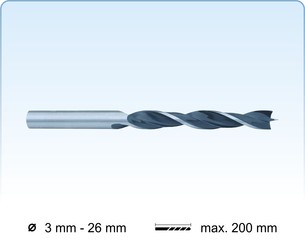
- Roll forged brad point wood drills (CrV)
A basic option suitable for standard DIY use and occasional drilling in soft to medium-hard wood. They are affordable and sufficient for typical installation tasks.
- HSS brad point wood drills, fully ground
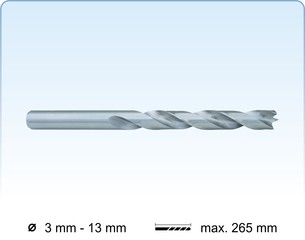
A more precise version with better cutting geometry. Suitable for more frequent use, higher demands on hole cleanliness, and longer tool life.
- TCT brad point wood drill bits
Designed for more demanding conditions and harder materials. The carbide tip increases wear resistance and makes it easier to start the hole even in dense or hard wood.
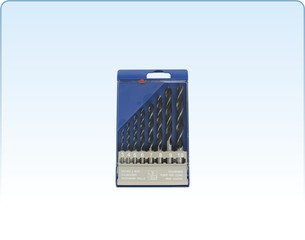
- Brad point wood drill sets
A practical solution if you need to cover multiple diameters and keep a basic range on hand for everyday work. Suitable for a workshop and for installation work in the field.
When choosing, consider how often you will use the drill bit, what material you will drill into, and what requirements you have for hole quality and accuracy.
Hide Description