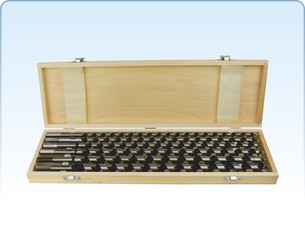
How to choose the right auger bit for wood
How to recognise an auger bit
An auger bit has a long, steep spiral that efficiently removes chips from deep holes. A typical feature is the pronounced self-feeding screw tip, which “pulls” the bit into the material without requiring heavy pressure.
Unlike a standard twist wood bit, an auger bit is much longer and is designed primarily for deep through holes. It is not suitable for shallow, highly precise holes with high requirements for a clean entry edge.
When choosing an auger bit, the key factors are drilling depth, hole diameter, and the tool you will be using.
By type of work and drilling depth
Auger bits are designed to remove chips efficiently during deep drilling. If you need to drill through thick beams or multiple layers of wood, an auger bit is more suitable than a standard twist bit.
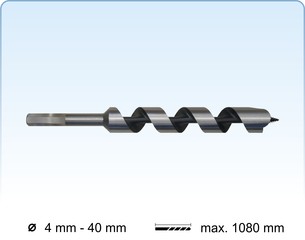
For typical construction and installation work, standard auger bits with hex shank are ideal. This group offers the widest selection of diameters and lengths, making it the most universal choice for most applications.
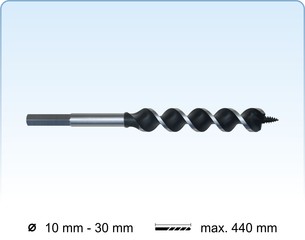
If you work with very thick structural members or need increased resistance under load, consider the reinforced (turbo) spiral version.
By tool power
For smaller diameters (roughly up to about 12–16 mm) and standard lengths, a powerful cordless drill/driver with sufficient torque may be enough – in this case hex-shank bits or the Quattro version (1/4" hex) are especially suitable, as they can be clamped directly in a bit holder.
As diameter and length increase, the load on the tool rises significantly. For larger diameters and long bits, a strong drill or an SDS-plus rotary hammer (always with hammer mode switched off) is more appropriate.
If you need excessive force or the machine slows down noticeably, the tool is underpowered and you should use a stronger tool or choose a different shank type.
By shank type
The most common option is auger bits with hex shank. The hex shank replaces a standard cylindrical shank – it is used in the same type of chuck – but the flats prevent slipping in the chuck under higher load. They are suitable for standard drills and more powerful cordless drills.
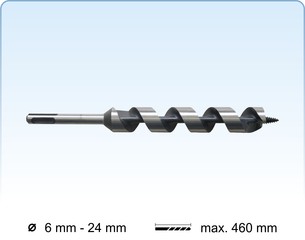
For rotary hammers, choose the SDS-plus shank version – when drilling wood, hammer mode must always be switched off.
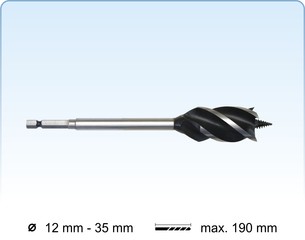
The special Quattro version is optimised for cordless drill/drivers. The shank is a standard 1/4" hex (the same size as common screwdriver bits), enabling quick clamping directly in a quick-change bit holder or a tool with a direct 1/4" output, without using a traditional chuck.
Before choosing, always check what shank type your tool supports and whether it has sufficient power and torque for the bit diameter you plan to use.
Where auger bits are used in practice
Auger bits are mainly used when working with solid wood and larger cross-section structural members.
Typical situations where they are used:
- drilling through beams when assembling pergolas, shelters, and timber structures,
- joining thick timbers using bolts or threaded rods,
- routing services (for example cabling) through wooden structures,
- carpentry work when building roof frames and load-bearing structures,
- assembling wooden stairs or frame constructions.
Thanks to the self-feeding screw tip and deep spiral, they are suitable where you need to pass through thick material quickly and safely without the hole clogging with chips.
How to work with auger bits
Auger bits are designed for deep drilling in solid wood, beams, timbers, and other wooden structural elements.
Choose a sufficiently powerful tool
Auger bits, especially in larger diameters, require higher torque. A weaker cordless driver can be overloaded or may twist suddenly out of your hands if the bit jams.
Hold the tool firmly and expect kickback
The self-feeding screw pulls the bit into the wood. If you hit knots or harder sections, the tool can jerk suddenly. Hold the drill firmly with both hands and stand in a stable position.
Drilling very deep holes
With long bits (for example around 1 metre), work progressively. First start the hole with a shorter bit of the same diameter so the entry is accurate and stable. Regularly pull the bit out and clear chips.
Never start drilling with a very long bit without a stable stance and enough free space around you – if the bit jams, the tool can move abruptly.
Monitor drilling progress and remove chips
Even though the spiral removes chips efficiently, in very deep holes you still need to pull the bit out periodically and clear the hole to prevent overheating or jamming.
Secure the workpiece
The drilled piece must be firmly fixed. With structural members, ensure the stability of the whole assembly.
Limitations and what to watch out for
Auger bits are not suitable for flat-bottom holes or for very precise furniture work where a clean edge without tear-out is required.
Common mistakes include using an underpowered tool, underestimating the sudden jerk when the bit locks, using hammer mode, or choosing an unsuitable shank type.
Note for small diameters (6–8 mm)
With small diameters around 6–8 mm, it can sometimes be easier to work with an extra-long metal drill bit than with an auger bit of the same diameter. The self-feeding screw tip actively pulls the auger bit into the wood, which can be less stable with a thin and long bit.
An extra-long metal drill bit advances only by its cutting edges based on applied pressure, and can feel calmer and more precise.
The recommendation is simple: try the auger bit first. If it does not work optimally, an extra-long metal drill bit can be a suitable alternative for these small diameters.
How the range is further divided
- Auger bits with hex shank
The most common version with a wide range of diameters and lengths. The hex shank prevents the bit from slipping in the chuck under higher load.
- Auger bits with SDS-plus shank
Designed for use with SDS-plus rotary hammers when drilling wood (always without hammer mode), especially on construction sites.
- Auger bits with reinforced turbo spiral
A more robust version for demanding use and higher loads.
- Quattro auger bits (1/4" hex)
A special design optimised for cordless drill/drivers. The shank is a standard 1/4" hex (the same size as common screwdriver bits), enabling quick clamping directly in a quick-change bit holder or a tool with a direct 1/4" output, without using a traditional chuck.
- Auger bit sets
A practical solution to cover multiple diameters for installation and construction work.
Hide Description