How to choose an SDS-plus core drill bit
With SDS-plus core drill bits, you primarily choose based on the required hole diameter. This depends on the specific job – most commonly the size of the electrical installation box or the diameter of a penetration for a cable or pipe.
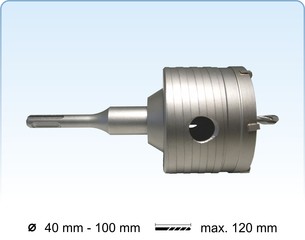
We offer the most commonly used diameters as ready-made sets. You simply choose the required size and order the core bit as a complete unit – everything you need is already included in the package, and the price is the same as buying the parts individually.
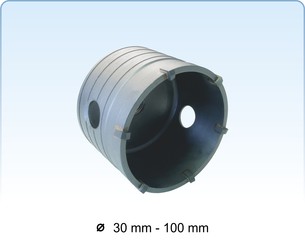
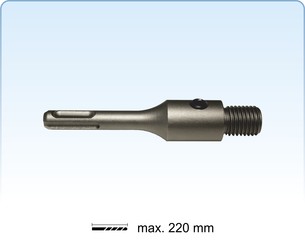
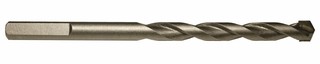
If you need a different diameter or a specific combination, you can assemble the core drill bit yourself. It consists of three parts – the core bit, the SDS-plus shank, and the pilot drill. The shank is supplied with the pilot drill, and additional pilot drills can be purchased separately as replacements.
When should you assemble your own core bit?
Building your own set makes sense when you need a less common diameter or a longer shank. A longer shank is useful, for example, when drilling into thicker walls, working through insulation, or wherever greater reach is required. In these cases, you choose the combination exactly according to the conditions on site.
The SDS-plus core bits in our range use an M16 thread that connects the core bit to the shank. If you choose a complete solution within this category, you do not need to worry about anything – the individual components are mutually compatible. However, the thread must be checked if you are purchasing only one part from us and want to use it with components bought elsewhere. There are other thread sizes on the market that are not interchangeable.
At first glance, core bits from different manufacturers may look similar. The difference becomes apparent in practice – in drilling accuracy, tool stability, and service life. The core bits in our range are designed for long-term load and perform reliably even in professional use. Compared to basic hobby versions, they differ in material quality and workmanship, which becomes especially noticeable with repeated drilling into harder concrete.
Where and how SDS-plus core drill bits are used in practice
SDS-plus core drill bits are used wherever you need to create a precise larger-diameter hole in concrete or masonry without chiseling and additional finishing.
The most common use is for electrical installations. You drill holes for installation boxes, multi-gang frames, or junction boxes. The standard diameter is 68 mm, but 80 mm is also used very often, giving you more installation allowance – for example, when you need more room for wires or easier seating of the box in a harder substrate.
SDS-plus core bits are also used for creating smaller penetrations for cables, plastic conduits, or smaller-diameter waste pipes. Typical situations include apartment and house renovations, where you need to route an installation between rooms, from a wall to a ceiling, or through a partition wall.
Other common diameters are approximately from 40 to 100 mm, depending on the type of installation and the specific device being installed.
A core bit is the right choice when using a twist drill bit would mean drilling multiple holes and then chiseling out material. With a core bit, you create the hole in one go—accurately and with a clean edge. However, it is important to consider that it is structurally limited in depth and is not intended for long through-drilling through thick structures.
For standard installation work, the SDS-plus system is fully sufficient. For larger diameters, very hard concrete, or repeated drilling in demanding conditions, a more powerful system may make sense, but for typical installations, SDS-plus is a sensible and efficient choice.
How to work with SDS-plus core drill bits
You use SDS-plus core drill bits with an SDS-plus rotary hammer or combi hammer. Unlike a twist drill bit, the core bit does not remove material across the entire hole area, but only along its perimeter. Your working method must be adapted accordingly.
With most concrete core bits, you work with hammer action. Pneumatic hammer action allows the core bit to advance smoothly without excessive feed pressure. If you push hard on the machine, drilling will not be faster – instead, you increase the load on the tool and on the hammer gearbox.
Recommendations for the drilling procedure
Hammer action and feed pressure
Let the hammer action and the cutting segments of the core bit do the work. Do not push with force. Hold the tool firmly, but without unnecessary overload.
Guiding the core bit
Start perpendicular to the surface and keep the machine stable. Wobbling or tilting causes uneven loading of the segments and reduces core bit life.
Material removal
During drilling, pull the core bit slightly out regularly so the drilled material can be released. If it stays inside, drilling slows down and the tool overheats unnecessarily.
Drilling depth
Core bits are structurally limited in depth. If you need more depth, you must drill gradually and remove the drilled core as you go, or choose another tool designed for deeper drilling.
Rules for work
- Do not push on the core bit – let the hammer action do the work.
- Work perpendicular and without deflecting the machine.
- Regularly release the drilled material.
- If drilling does not run smoothly, check the condition of the core bit or the machine power.
Safety notice
- Use safety glasses and, for longer work, also hearing protection.
- Before drilling, always check that there are no cables, water, or gas lines in the area.
- Hold the machine with both hands, especially when the core bit bites.
- When drilling overhead, expect falling dust and material.
- Do not use a damaged or heavily worn core bit.
How is the range further structured?
The category of SDS-plus core drill bits leads directly to specific products and individual components that you can use to assemble a complete tool as needed.
In the range you will find:
Depending on whether you want a ready-made set or need to build your own combination, you choose the specific product and then the required variant.
Hide Description