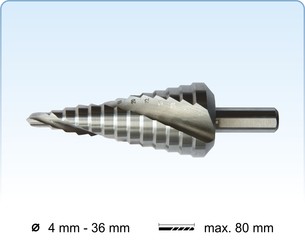
How to choose the right step drill for metal
A step drill is the right choice when you need to drill into thin-walled materials while working with precisely defined hole diameters. It is ideal wherever you want to enlarge a hole gradually in individual steps and maintain greater control over the final size. If instead you need to adjust the hole size more continuously between dimensions, a Tube and sheet drill is usually a better option.
The choice mainly depends on the difficulty of the work and the machined material. The standard HSS version is suitable for regular applications. If you want smoother operation and better chip removal, variants with spiral flutes are a better choice. For heavier workloads, versions with a TiAlN coating are recommended, as the coating increases heat resistance and contributes to longer tool life. For the most demanding applications and drilling stainless steel, HSS-Co + TiAlN step drills with spiral flutes are designed.
Where and how step drills for metal are used
Step drills are mainly used for drilling into sheet metal, profiles, tubes, and other thin-walled materials. They are widely used in workshops, installation work, maintenance, and metal part modifications wherever you need not only to drill a hole, but also gradually enlarge it to a specific required diameter.
The main advantage of the step design is working with predefined dimensions. The individual steps allow you to move between sizes progressively, making step drills suitable wherever maintaining a precise final hole diameter is more important than transitioning smoothly between intermediate sizes.
They can be used in hand drills, cordless drills, and drill presses with a chuck. For more accurate work and better drill guidance, the use of a pillar or bench drill is recommended.
How to work with step drills for metal
When drilling, work smoothly without excessive pressure and adjust the speed according to the drilled material and hole diameter. For larger diameters or more demanding materials, it is recommended to use cutting oil or cutting paste, which reduce friction, limit overheating, and help extend tool life.
Variants with a TiAlN coating are more suitable for prolonged loads and demanding applications thanks to their higher heat resistance. When drilling stainless steel or harder materials, proper cooling and lubrication are especially important. Versions with spiral flutes provide smoother operation and better chip removal.
For accurate results, always ensure the workpiece is firmly clamped and the drill is guided steadily. The use of safety glasses and careful handling of chips and the workpiece after drilling should also be standard practice.
How does the selection continue?
Step drills for metal in this category are divided according to their design:
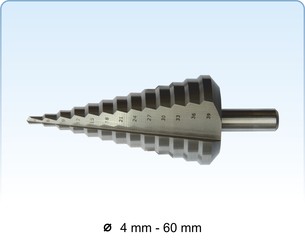
- HSS step drills
Basic version for standard drilling into sheet metal, profiles, and other common metal materials. Suitable for regular workshop and installation use.
- HSS step drills with spiral flutes
A version suitable for smoother drilling and better chip removal. Ideal for more frequent use or wherever smoother drill operation is important.
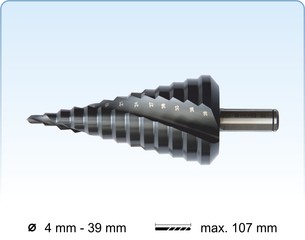
- HSS + TiAlN step drills with spiral flutes
A version with higher heat resistance and longer service life. Suitable for demanding applications, prolonged workloads, and frequent drilling.
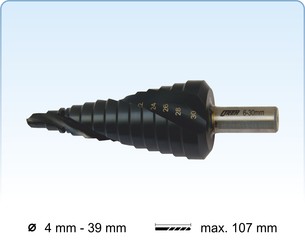
- HSS-Co + TiAlN step drills with spiral flutes
The highest-performance version designed for demanding applications and drilling stainless steel. The combination of cobalt steel, spiral flutes, and a TiAlN coating ensures high durability when drilling harder materials.
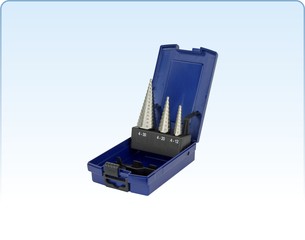
- Step drill sets
A practical solution for workshops and installation work where you need multiple diameter ranges in one package.
Hide Description