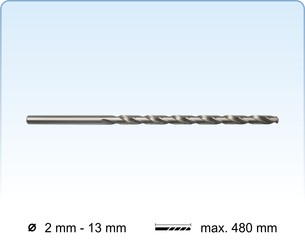
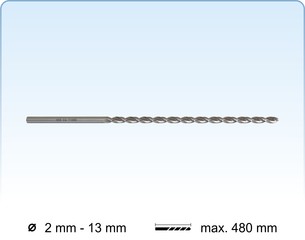
How to choose the right DIN 1869 metal drill bit
An extra-long drill bit places higher demands on both the machine and the operator. The correct choice depends mainly on drilling depth, material type, and required precision.
Drill bit material
Fully ground HSS DIN 1869
Suitable for deep drilling into structural steel, cast iron, and non-ferrous metals. Designed for standard deep holes without extreme thermal load.
Fully ground HSS-Co DIN 1869
Designed for deep drilling into stainless steel, alloyed, and high-strength steels where standard HSS may not provide sufficient durability. Higher heat resistance is essential, as deep drilling generates more heat.
Series I, II, and III
Within DIN 1869, drill bits are divided into three length series:
- Series I – the shortest of the extra-long versions
- Series II – medium length
- Series III – the longest version with maximum reach
As length increases, stability requirements also increase. If maximum length is not necessary, it is always better to choose a shorter and more rigid version.
Depth and stability
DIN 1869 is designed exclusively for very deep holes.
You must take into account:
- greater tool overhang,
- higher susceptibility to deflection,
- the need for stable and perpendicular guidance.
If extra length is not required, it is preferable to use DIN 338 drill bits or DIN 340 drill bits, which are more rigid and stable.
Where and how DIN 1869 metal drill bits are used
They are mainly used for:
- drilling deep holes in steel structures,
- working through multiple material layers,
- manufacturing deep holes in workshop production,
- special structural applications.
Metal drilling must always be performed without hammer action.
Use in other materials
In practice, extra-long HSS drill bits can also be used for drilling deeper holes in wood or plastics, especially in smaller diameters.
However, they are not primarily designed for wood. For deep drilling in wood, an auger bit with a threaded tip is more suitable, as it removes chips more efficiently and provides more stable guidance.
Using an HSS drill bit in wood is particularly suitable where higher precision is required or where a combination of materials must be drilled (e.g., wood with metal reinforcement).
How to work with DIN 1869 metal drill bits
Extra length places maximum demands on drilling technique.
Basic rules
- Always drill without hammer action.
- Use lower speeds than with shorter drill bits of the same diameter.
- Work with moderate and steady feed pressure.
- Regularly withdraw the drill bit to remove chips.
Lubrication and cooling
Deep metal drilling generates more heat. Using cutting oil or cutting paste significantly reduces heat buildup and the risk of seizing.
Stability
The workpiece must be firmly secured. For deep holes, using a drill press or column drill is recommended. Hand drilling deep holes requires experience and stable guidance.
Work safety
- Wear safety glasses.
- Do not wear loose clothing or sleeves.
- Do not remove chips by hand or while the machine is running.
Hide Description