How to choose the right Concrete drill bit
Concrete drill bits are designed for drilling into masonry and concrete using a standard impact drill or a cordless drill/driver with mechanical hammer action. If you need to drill into floor tiles, wall tiles, or other hard surfaces, you must choose a different type of drill bit designed for those materials – see the section Drilling into floor and wall tiles.
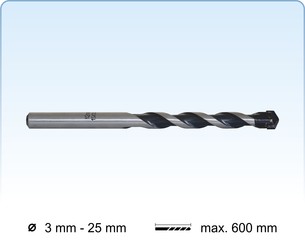
The selection in this category is not complicated. In our e-shop, the range branches into two types of hammer drill bits that are very similar for typical use. In the KLASIK version we offer a wider size range – diameters from 3 mm up to 25 mm and lengths up to 600 mm. In the PROFI version the size range is more limited. So it is not a fundamental difference in purpose, but rather the breadth of the assortment and personal preference regarding the design style.
Today, hammer drill bits are used mainly for hobby and lighter installation work – that is, where you work with a standard drill and do not have a rotary hammer with pneumatic hammer action available. If you drill more often into hard concrete or need larger diameters, it is better to move to the SDS-plus system
Where and what you will use Concrete drill bits for in practice
Concrete drill bits with a cylindrical shank are used mainly for everyday household and lighter installation work where you drill into masonry or concrete using a standard impact drill or a cordless drill/driver with hammer action enabled. Typical jobs include installing shelves, curtain rods, lights, brackets, consoles, and other items anchored into a wall.
Most commonly, you work with small to medium diameters, approximately from 4 to 12 mm, which correspond to standard wall plugs and anchors used in households. In these sizes, a good quality impact drill is fully sufficient and drilling can be done without using a rotary hammer.
The diameter range in the KLASIK version goes up to 25 mm and lengths up to 600 mm, which also allows drilling through thicker structures. However, you need to keep in mind that the larger the diameter and the longer the bit, the more the limits of a standard drill will show – the work is slower, the tool heats up more, and drilling requires better stability.
This is where the difference compared to SDS systems becomes clear. The mechanical hammer action of a standard drill has lower impact energy than the pneumatic hammer action of a rotary hammer. For occasional drilling into masonry, this is a fully sufficient solution. But if you drill regularly into hard concrete, work with larger diameters, or need to drill a higher number of holes, it is better to use a rotary hammer with the SDS-plus system.
How to work with Concrete drill bits
Concrete drill bits with a cylindrical shank are used in standard impact drills or more powerful cordless drill/drivers with mechanical hammer action enabled. Unlike the SDS system, there is no pneumatic mechanism here – the hammer action is mechanical and generated by the gearbox inside the drill.
The impact energy is therefore lower and drilling depends more on correct technique. For smaller diameters and typical installation tasks, however, this method is fully sufficient.
The following recommendations will help the work run smoothly and without unnecessary wear of both the drill bit and the machine.
Recommendations for the drilling procedure
Hammer action and its role in practice
When drilling into concrete and solid masonry, always keep hammer action switched on. Without hammer action, the bit only heats up and progress is very slow.
Hole guidance and feed pressure
Do not push too hard. Mechanical hammer action works with a combination of speed and light feed pressure. Excessive force increases heat, wear of the carbide tip, and loads the drill’s gearbox. Keep the tool stable and perpendicular to the surface.
Pilot drilling with larger diameters and longer bits
With larger diameters or when using a weaker drill, pilot drilling with a smaller diameter can help. It improves guidance and reduces the initial load on the machine. For common wall-plug diameters (e.g., 6–10 mm), pilot drilling is usually not necessary.
Removal of drilled material
When drilling deeper holes, regularly pull the bit out of the hole so dust can be removed. If the hole is not cleared, drilling slows down, the bit heats up, and the process becomes less efficient.
Contact with reinforcement
Hammer drill bits are not primarily intended for systematic drilling into reinforced concrete. If you hit rebar, do not push harder and do not try to “force” your way through. In such a situation, it is better to use a tool designed for more demanding conditions.
Work rules
- Do not apply excessive force – let the speed and hammer action do the work.
- For larger diameters or longer holes, consider pilot drilling with a smaller diameter.
- Regularly pull the bit out of the hole and clear out dust.
- If you hit reinforcement, do not overload the machine or the tool.
- If progress is not smooth, consider using a more powerful machine (SDS-plus).
Safety warnings
- Wear safety glasses and, for longer drilling, hearing protection.
- Before drilling into walls, always check that there are no cables, water, or gas lines in the area.
- Hold the machine firmly with both hands, especially when starting the hole.
- When drilling overhead, expect falling dust and material.
- Regularly check the carbide tip condition – a damaged bit increases the risk of the hole wandering off line.
What are the limitations of drilling with hammer drill bits
Concrete drill bits are intended mainly for small to medium diameters for common installation work in households and light-duty environments. Typically, this means holes up to about 12–16 mm, depending on the power of the drill you use.
With larger diameters (for example above 16–18 mm) or longer drill bits, the limitations of mechanical hammer action become very apparent. Drilling is slower, the machine heats up more, and the work requires more physical control.
Concrete drill bits with a cylindrical shank are not suitable for regular drilling into hard and reinforced concrete. If you need to drill frequently, in larger volumes, or into harder material, it is better to use a rotary hammer with the SDS-plus system, which is designed for this load.
How is the range further structured?
In this category, you move on to three main subcategories:
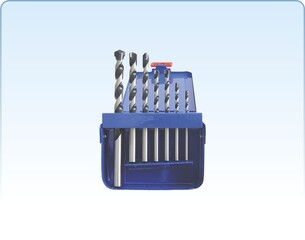
Sets of Concrete drill bits are a practical solution when you want to have the most commonly used diameters at hand in one package. They are suitable for the home, a service bag, or as a basic workshop set. You do not need to deal with individual pieces – you get a clear combination of sizes for common wall plugs and installation work.
Individual drill bits are then selected in these two versions:
Both variants are designed for drilling into masonry and concrete with a standard impact drill or a cordless drill/driver with hammer action. They are not two different quality classes, but two designs with the same intended use.
The KLASIK line offers a wider size range – diameters up to 25 mm and lengths up to 600 mm (this is not a 25 × 600 mm combination). So if you are looking for a specific diameter or a longer version, you will most likely find it here.
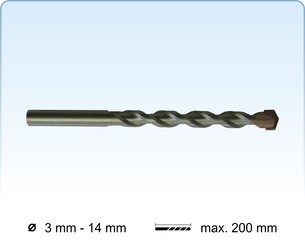
The PROFI line has a more limited size range, but for typical use it serves the same function. The choice is therefore mainly a matter of the available size and personal design preference.
When choosing a subcategory, focus mainly on the required diameter, the drill bit length, and the power of the machine you will be using.
Hide Description