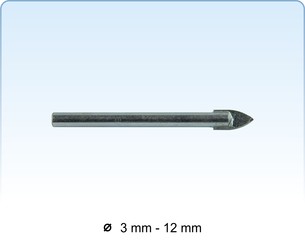
How to choose a glass drill bit
Choosing a glass drill bit is determined mainly by the hole diameter and the type of work.
1️⃣ What hole diameter do you need?
Most common applications:
- installing holders, handles, and small fittings into glass,
- drilling holes in mirrors,
- small installation work in glazed ceramics.
With glass, it is essential to choose the exact diameter – no clearance is added. Glass cannot be “opened up” or adjusted afterwards without risk of damage.
For larger diameters or thicker glass, you can also use diamond hole saws designed for non-hammer drilling with cooling.
Where and how glass drilling is used in practice
Glass drilling is mainly done during interior installations:
- installing bathroom accessories into glass panels,
- modifying mirrors,
- technical holes in glass infills,
- small installation work in glazed wall tiles.
The work is typically done on a finished, visible surface, where any damage is irreversible. That is why control matters more than speed.
How to work with glass drill bits
Basic rules:
- never use hammer action,
- drill at low speed,
- do not force it,
- start drilling carefully and keep the tool stable.
When drilling larger diameters or thicker glass, cooling (e.g., with water) is recommended to reduce heat and stress in the material.
Typical risks
- cracking the glass due to hammer action or excessive pressure,
- the drill bit slipping on a smooth surface,
- micro-cracks caused by overheating.
How does the selection continue?
This subcategory contains one product group:
Glass drill bits
Drill bits designed for non-hammer drilling into glass, mirrors, and glazed ceramics.
Suitable for precise and controlled drilling of small holes in brittle materials.
When choosing, focus mainly on the hole diameter and the material type.
Hide Description