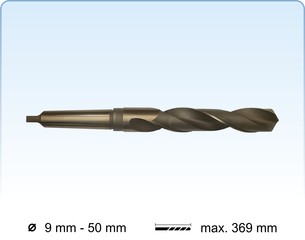
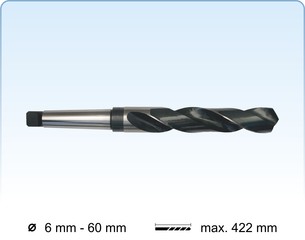
How to choose the right metal drill bit with a Morse taper
The main selection criteria are the material being drilled, the required hole depth, the drill diameter and the Morse taper size of the machine. The individual designs are not simply more or less durable versions of the same drill bit. Each type is intended for a different application:
- For common structural, alloyed and unalloyed steels, iron, cast iron and non-ferrous metals, standard HSS drill bits manufactured to DIN 345 are suitable.
- For stainless and higher-strength steels, choose HSS-Co 5% cobalt drill bits, which provide better resistance to the higher temperatures generated during drilling.
- For deeper holes or drilling through drill bushes, long-series HSS drill bits manufactured to DIN 341 are intended.
- For wear-resistant Hardox 350 and 400 plate and manganese steel, use special HSS-Co8 drill bits with a modified cutting geometry.
- For spring steel, hard cast iron and other hard or highly abrasive materials, drill bits manufactured to DIN 8041 with a carbide-tipped cutting section are intended.
The Morse taper size of the drill bit must match the machine spindle. Where the sizes differ, they can be adapted within the permitted range by using a suitable reducing sleeve or extension sleeve. For holes of standard depth, a shorter and more rigid DIN 345 drill bit is preferable. Choose a long-series design only when the standard length is insufficient.
Where Morse taper drill bits are used
Taper-shank drill bits are primarily used in bench and industrial drilling machines equipped with a corresponding Morse taper. They are used in workshops, tool rooms, maintenance departments and engineering production, particularly for drilling larger diameters, deeper holes or difficult-to-machine materials.
Standard HSS drill bits and HSS-Co 5% cobalt drill bits cover common workshop and production applications. Long-series drill bits are used when it is necessary to reach deeper into the workpiece. HSS-Co8 drill bits and carbide-tipped drill bits are specialised tools for specific difficult-to-machine materials and are not a universal replacement for standard drill bits.
All these drill bits require a stable machine and secure clamping of the workpiece. They are not intended for conventional hand-held drilling, where accurate coaxial tool guidance and smooth operation without lateral loading cannot be reliably ensured.
How to work with Morse taper drill bits
Before mounting the drill bit, check that both the taper shank and the spindle socket are clean, undamaged and free from chips or debris. The drill bit must seat correctly in the taper. An incorrect taper size or contaminated contact surfaces can cause inaccurate running and insufficiently secure mounting.
The workpiece must be securely clamped before drilling. The speed and feed rate should be selected according to the drill diameter, tool material and workpiece material. Lower speeds and a steady feed are particularly important when drilling larger diameters. When drilling metal, use a suitable cutting oil, cutting paste or other appropriate cooling and lubrication for the material.
When drilling deeper holes, chips must be removed regularly and the long-series drill bit must not be overloaded by lateral pressure. Carbide-tipped drill bits require smooth operation without impacts or vibration. When drilling Hardox and manganese steel, the cutting edge must continuously produce a chip. Allowing the drill bit merely to rub against the surface can further work-harden the drilling area.
After use, remove the drill bit with a suitable Morse taper drift. Do not knock it out with an unsuitable tool that could damage the drill bit or the machine spindle.
How is the range further divided?
Metal drill bits with a taper shank in this category are divided according to the tool material, length and type of material being machined:
Hide