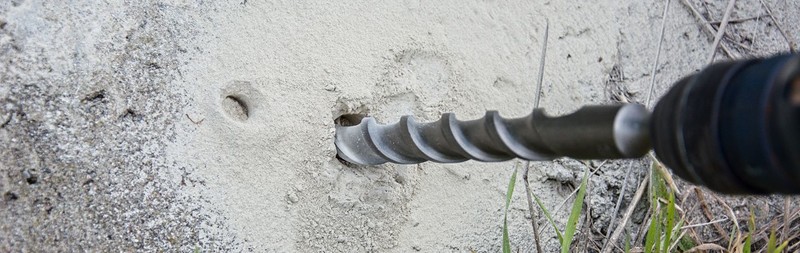
How to choose the right tool for drilling into concrete
The correct choice of tool determines whether the required hole can be made at all, how quickly the work will proceed and the quality of the final result. The combination of the selected machine, the appropriate chucking system and the type of tool defines the limits of individual options – for example, whether an impact drill is sufficient for small anchor holes or whether an SDS-max rotary hammer is required for larger diameters, deeper drilling or breakthrough drilling.
How to proceed with the selection in practice
When choosing a tool for drilling into concrete, it is essential to follow the correct order:
- The machine you have available – the type of tool (standard drill, impact drill, rotary hammer) is the starting point of the entire selection.
- The chucking system supported by the machine – the tool automatically determines the possible shank types (cylindrical shank, SDS-plus, SDS-max) and thus the range of tools available.
- Required hole diameter and depth – based on this, you decide whether a twist drill bit (common small to medium diameters, deeper holes) or a core bit (larger diameters, typically holes for electrical installation boxes and penetrations) is more suitable. For both types, available sizes always depend on the selected tool group and the capabilities of the machine.
If the required diameter or length does not exist within the given tool group, this is usually a sign that the hole exceeds the capabilities of the machine you intended to use, and more powerful equipment should be considered.
Where and how concrete drilling is used in practice
Drilling into concrete and masonry is a common part of:
- construction and renovation work,
- installation of anchors, wall plugs and threaded rods,
- electrical installations and wiring,
- installation of air conditioning, ventilation and sanitary systems,
- wall and ceiling penetrations.
These are typically situations where shelves, cabinets or load-bearing elements need to be fixed, structures attached to walls or ceilings, cables, pipes or ducts routed, or openings created between rooms. The requirements for hole diameter, depth and machine power vary significantly depending on the task.
Different types of work place different demands on equipment. Some common installation holes can be handled with a cordless screwdriver or impact drill, while larger diameters, deeper drilling or breakthrough drilling require more powerful machines such as SDS-max rotary hammers or specialised core drilling machines. The chosen equipment directly determines the available tool types and shank systems.
How to work with tools for drilling into concrete
Impact drills or rotary hammers equipped with hammer action are commonly used for drilling into concrete. The mechanical hammer action of impact drills is sufficient mainly for smaller diameters and lighter work. For larger diameters, deeper drilling and breakthroughs, the pneumatic hammer action of rotary hammers is significantly more effective. These machines are now affordable and are not intended only for professional companies. If you are facing a larger project, such as a flat or house renovation, investing in a rotary hammer pays off – the work is considerably easier and gives access to a much wider range of suitable tools.
The following recommendations should be taken into account to ensure smooth work, good results and to avoid unnecessary damage to the drill bit, machine or accessories.
Drilling procedure recommendations
Hammer type and its importance in practice – when drilling into concrete, the type and strength of the hammer action are crucial and depend on the machine used. Mechanical hammer action is sufficient for smaller diameters, while pneumatic hammer action is necessary for demanding work. The exception is core drilling, which is always performed without hammer action.
Drill guidance and pressure – the drill bit should work mainly through the hammer action and the weight of the machine. Do not apply excessive pressure – too much force slows progress and increases tool wear.
Pilot drilling for deep and breakthrough holes – with long drill bits, always pre-drill using a shorter bit of the same diameter. Drilling directly with a long bit leads to poor guidance, vibration and excessive tool stress.
Removal of drilled material – during deep drilling, regularly pull the drill bit out of the hole. If dust is not removed, the bit clogs, friction increases and overheating occurs, typically when drilling into floors.
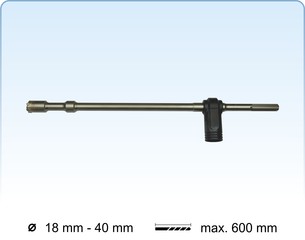
Drilling into reinforced concrete – when contacting reinforcement, do not apply excessive pressure or try to force the drill through. Use drill bits with multi-cut geometry or a solid carbide head. For these situations, we also offer special drill bits designed exclusively for drilling through reinforcement, used as auxiliary tools when hitting rebar.
Working rules
- Do not apply pressure to the drill bit – let the hammer action and machine weight do the work.
- For deep holes and breakthroughs, always pre-drill with a shorter bit of the same diameter.
- Regularly pull the drill bit out of the hole to prevent clogging with dust.
- When contacting reinforcement, do not overload the machine or the drill bit.
- If the work does not proceed smoothly, consider using a more powerful machine or a more suitable tool type.
Safety instructions
- Wear safety glasses and hearing protection during extended drilling.
- When drilling into walls and ceilings, always check for electrical cables, water or gas lines.
- Hold the machine firmly with both hands, especially when the drill bit engages or contacts reinforcement.
- When drilling overhead or into floors, take extra care due to falling material and dust.
- Regularly check the condition of the drill bit – a dull or damaged bit increases the risk of injury and machine damage.
Which types of tools you can choose for drilling into concrete
The drilling into concrete category is divided into specific subcategories that you can browse further based on tool type, shank system and work characteristics. Each subcategory represents a distinct group of tools with clearly defined usage, diameter range and typical applications.
- Concrete drill bits
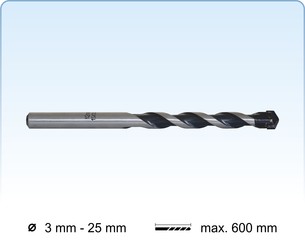
Drill bits with a cylindrical shank designed for impact drills and cordless drivers with hammer function. They are mainly used for smaller diameters and common installation work such as drilling holes for wall plugs and light anchoring.
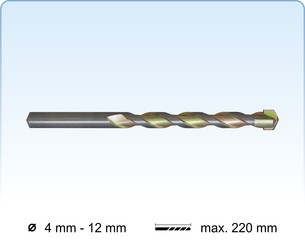
- Universal drill bits
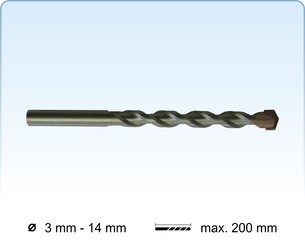
Drill bits with a cylindrical shank and specially shaped tip that allow drilling into masonry and light concrete, as well as tiles, ceramics, glass and other glazed materials. They are used in impact drills and cordless drivers but always without hammer action. Typically available in smaller diameters for installation and assembly work.
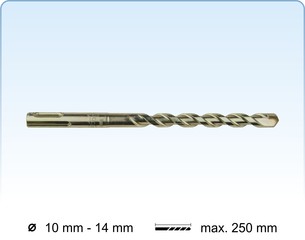
- SDS-plus drill bits
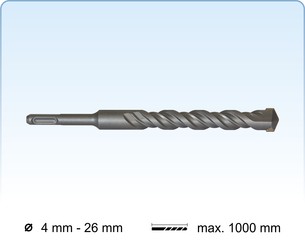
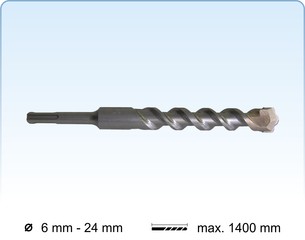
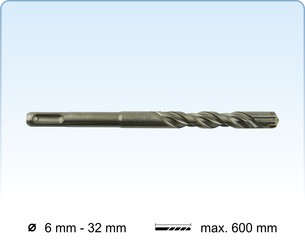
Drill bits with SDS-plus shank for small rotary hammers. Various designs are available – two-cut, four-cut or versions with a solid carbide head that better handle demanding drilling and occasional contact with reinforcement. They typically cover diameters from approximately 5 to 32 mm, with selected versions available in extended lengths up to approx. 1400 mm, especially suitable for breakthrough drilling.
- SDS-max drill bits
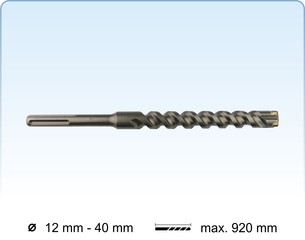
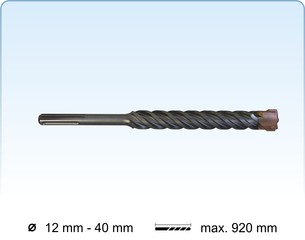
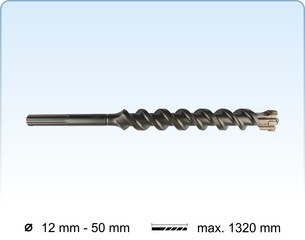
Drill bits with SDS-max shank designed for large electro-pneumatic hammers. They are used for high-performance drilling and breakthroughs in concrete. Diameters range from 12 mm to 50 mm, with some sizes available in lengths up to approx. 1250 mm, enabling deeper and breakthrough drilling.
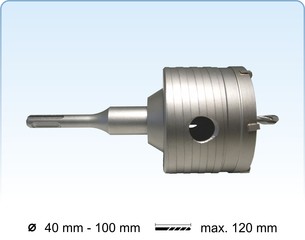
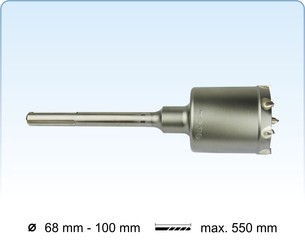
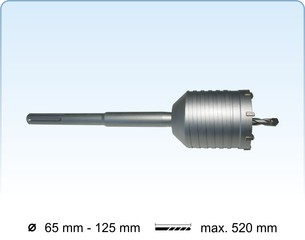
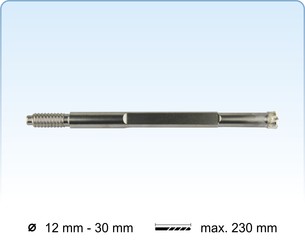
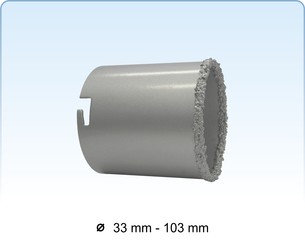
- Core drills
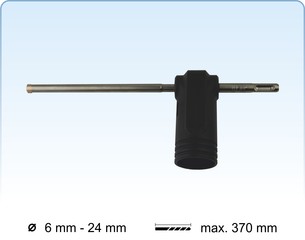
Tools for drilling diameters significantly larger than those achievable with twist drill bits, typically for electrical installation boxes or larger penetrations. Compared to twist drill bits, drilling depth is structurally limited, so they are not intended for long breakthroughs.
- Variable driling system VARIANT
A modular system designed for breakthrough drilling and creating larger openings. It allows drilling into larger diameters (e.g. approx. 150 mm) and, thanks to its modular design, the assembly length can be adapted to specific requirements. It is suitable for large-diameter breakthroughs beyond what is commonly achievable with SDS-max drill bits.
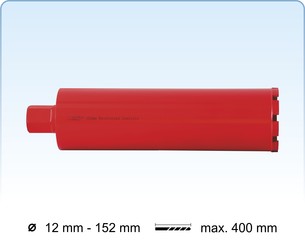
- Diamond core drill bits
Tools for core drilling without hammer action, using water cooling. They are used for precise circular holes of larger diameters, especially where high cut quality and minimal damage to surrounding material are required.
- Concrete drill bit sets
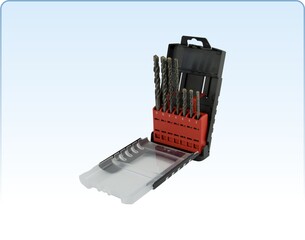
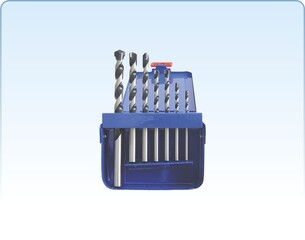
Practical sets of the most commonly used diameters for standard drilling and installation work. They are an ideal choice as basic workshop equipment and as a reliable part of a tradesperson’s daily service and installation toolkit.
Hide