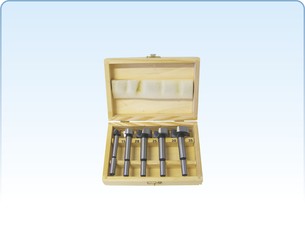
How to choose the right Forstner bit
When choosing a Forstner bit, first clarify what exactly you will be drilling and what material you will be working with.
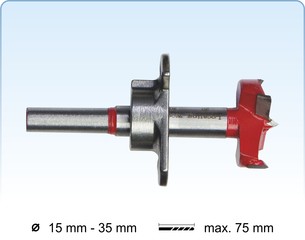
Are you installing cabinet hinges (e.g. 35 mm concealed hinges)?
Choose a Machine cylinder boring bits with depth adjustment.
It allows you to set the drilling depth precisely and prevents drilling through the door. It is ideal for kitchen production, wardrobes, or repeated furniture assembly.
Do you need a precise blind hole with a flat bottom (e.g. for hardware, screw recessing, dowel joints)?
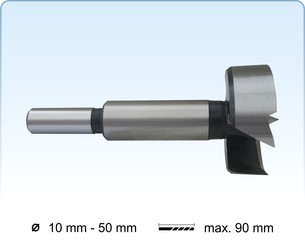
Choose a classic non-toothed Forstner bit DIN 7483 G.
It is a universal choice for standard woodworking in solid wood, plywood, or MDF.
Do you drill often or in larger quantities (e.g. furniture production)?
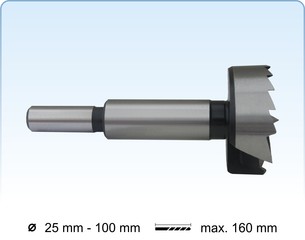
Choose a toothed Forstner bit DIN 7483 G.
It is suitable for the same type of work as the non-toothed version, but thanks to the toothed rim cutter it heats up less and cuts with lower resistance. This is especially helpful during repeated or longer work, mainly in softwood and sheet materials.
Are you working with very hard material?
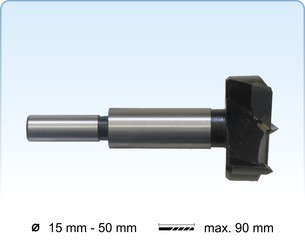
Choose a carbide-tipped Machine cylinder boring bits.
It is suitable, for example, for:
- oak, beech, ash
- exotic hardwoods
- laminated boards
- materials with higher density or glued layers
Carbide cutting edges offer longer service life and better wear resistance.
Do you need a through hole during construction/assembly?
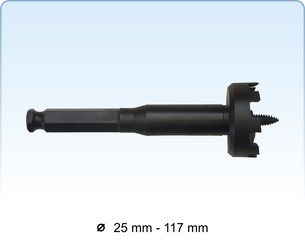
Choose a Forstner bits self-feed.
It is useful for example when assembling timber structures, pergolas, frame constructions, or when routing installations through structural elements. It allows you to create a precise hole even when passing through multiple material layers.
The advantage is the option to combine it with an extension, which helps you reach greater depth than with a standard Forstner bit. This is especially useful in thicker structural members.
Where Forstner bits are used in practice
Forstner bits are used wherever the exact hole shape and a perfectly flat bottom matter. Unlike twist or auger bits, they are not intended for deep through drilling, but for precise material machining.
Typical practical uses:
- drilling holes for concealed cabinet hinges (e.g. 26 mm or 35 mm),
- recessing hinges, fittings, and mounting hardware,
- creating precise dowel joints in furniture making,
- recessing screw heads or nuts,
- drilling close to the edge without tear-out,
- creating partial holes (e.g. overlapping holes when making a pocket or groove).
They are used mainly in furniture production, kitchens, interior elements, doors, and carpentry installations.
Thanks to their design, they can also drill cleanly in laminated boards or MDF, provided the tool is chosen correctly and guided properly.
How to work with Forstner bits
Always use Forstner bits without hammer action.
Use a suitable machine and ensure guidance
Best results are achieved with a drill press or a drill with solid guidance. A Forstner bit is guided mainly by the rim cutter and is sensitive to perpendicularity.
Handheld drilling is possible, but you must start perfectly perpendicular to the surface. With larger diameters, stability becomes more demanding, and an angled start can lead to an off-centre hole.
Choose the right speed
With larger diameters, always start at lower RPM and increase slightly if needed. Smaller diameters can handle higher RPM.
Too high RPM is indicated by heating, darkening of the wood, or smell.
Too low RPM shows as a jerky cut, stronger vibration, and unnecessary pressure you have to apply.
The correct setting results in a smooth cut without excessive resistance.
Do not apply excessive pressure
A Forstner bit cuts with its rim cutter and removes material with its front cutting edges. Too much pressure can worsen the flatness of the hole bottom or cause overheating.
Let the tool work with its cutting geometry.
Work smoothly when drilling blind holes
When drilling deeper blind holes, lift the bit occasionally to remove chips and reduce heating.
Especially with larger diameters, gradual drilling without heavy pressure helps.
Limitations and what to watch out for
Forstner bits are not suitable for deep through drilling in beams or for situations where fast penetration of thick material is needed – a different drill bit type is better for that.
With larger diameters, expect higher load on the machine – for precise work a drill press is recommended.
Which types of Forstner bits you can choose from next
Forstner bits are further divided by rim design and intended use.
Hide Description