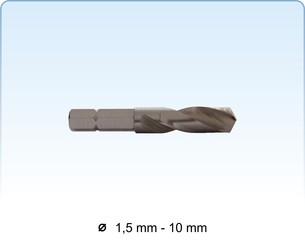
How to choose the right 1/4" hex shank drill bit
When selecting, it is important to consider mainly the type of tool and the scope of work.
Tool type
These drill bits are designed for tools equipped with a 1/4" bit holder – typically cordless screwdrivers or combination drill drivers.
They are not intended for machines with Morse taper shanks or for heavy industrial drilling.
Hole diameter
They are usually available in smaller diameters (approx. 1.5–10 mm).
They are suitable for standard installation holes, pilot drilling, or lighter structural work.
For larger diameters, conventional drill bits with a cylindrical shank are more appropriate.
Material being drilled
Standard HSS versions are suitable for:
- unalloyed and alloy steels,
- iron and cast iron,
- non-ferrous metals.
When drilling stainless steel, higher load and shorter service life must be expected – in such cases, specialized drill bits may be more suitable.
Where and how hex shank drill bits are used
They are mainly used for:
- installation work,
- structural assembly,
- drilling holes for screws and fasteners,
- working at height or in confined spaces.
The main advantage is quick tool change without adjusting a chuck.
Drilling must always be performed without hammer action.
How to work with hex shank drill bits
When working, it is important to:
- use low to medium speeds depending on diameter,
- avoid excessive feed pressure,
- consider pre-drilling for larger diameters,
- hold the tool firmly, as the hex shank transfers torque directly without slipping.
These drill bits are primarily intended for mobile and installation work, not for heavy-duty or continuous industrial drilling.
Hide Description