How to choose the right DIN 340 metal drill bit
Within the extended DIN 340 length range, drill bits differ in material, manufacturing method, and point geometry. The correct choice depends mainly on the required drilling depth, material hardness, and required precision.
Material you will be drilling into
For standard structural steels, cast iron, and non-ferrous metals, high-speed steel (HSS) drill bits are suitable.
For stainless steel and stronger materials, cobalt versions (HSS-Co) are recommended, as they better withstand the heat generated during longer drilling operations.
Accuracy and drilling stability
An extended drill bit has greater overhang and is therefore more prone to deflection.
For more precise work and smoother operation, ground versions are recommended. For deeper holes, it is essential to maintain perpendicular guidance and secure clamping of the workpiece.
Hole depth
DIN 340 is designed for deeper drilling than DIN 338.
If even greater reach is required, extra-long DIN 1869 drill bits are used.
If increased depth is not necessary, it is better to use standard DIN 338 drill bits, which are more rigid and stable.
A detailed overview of the available versions in this subcategory can be found below in the section “How does the selection continue?”.
Where and how DIN 340 metal drill bits are used
DIN 340 drill bits are mainly used for:
- drilling deeper holes in steel profiles,
- working through thicker materials or multiple layers,
- applications requiring greater reach,
- structural and installation work.
They are suitable for hand drills, cordless drills, and bench drills with a standard chuck.
Due to their increased length, they require more careful handling than standard drill bits and stable guidance must be ensured.
⚠️ Metal drilling must always be performed without hammer action.
How to work with DIN 340 metal drill bits
A longer drill bit places higher demands on drilling technique.
Basic drilling rules
- Always drill without hammer action.
- Use lower speeds than with shorter drill bits of the same diameter.
- Work smoothly without excessive feed pressure.
- For deeper holes, regularly withdraw the drill bit to remove chips.
Lubrication and cooling
Deeper drilling generates more heat.
Using cutting oil or paste significantly reduces heat and extends drill bit life.
Tool stability and guidance
The workpiece must be firmly secured.
For more precise work, a drill press is recommended.
When drilling by hand, special attention must be paid to perpendicular alignment and even pressure.
Work safety
- Wear safety glasses.
- Do not wear loose clothing, sleeves, or chains.
- Do not remove chips by hand or while the machine is running.
Important notice:
Pneumatic or electric hammers with SDS-plus shanks are not suitable for metal drilling.
How does the selection continue?
Within the DIN 340 drill bit range, the selection is divided according to material and manufacturing quality.
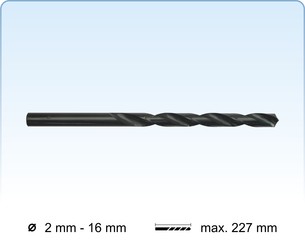
Rolled HSS drill bits DIN 340
Suitable for standard deeper drilling into structural steel and non-ferrous metals.
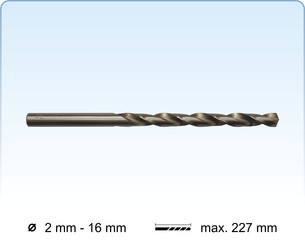
Ground HSS drill bits DIN 340
Suitable for more precise deeper holes and professional regular use.
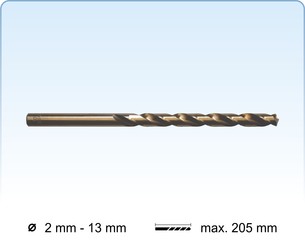
Ground cobalt drill bits (HSS-Co) DIN 340
Designed for deeper drilling in stainless steel and high-strength steels where standard HSS versions may not be sufficient.
Hide Description