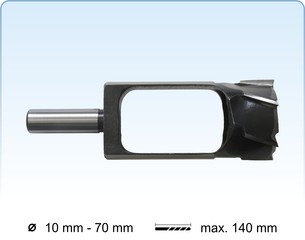
When to choose a plug cutter
A plug cutter is suitable when:
- you want to hide the head of a screw or wood screw on a visible surface,
- you are repairing minor defects or drilled holes,
- you need an aesthetically clean solution without visible fasteners,
- you are working with solid wood and want to maintain a uniform material appearance.
For best results, use a plug cutter and a Forstner bit of the same diameter.
Where plug cutters are used in practice
Plug cutters are mainly used in carpentry and furniture production.
Typical uses:
- covering screws in solid wood furniture,
- repairing minor wood damage,
- aesthetic finishing of joints in interior elements,
- producing custom wooden plugs that match the specific material.
Using plugs made from the same wood allows you to achieve an almost invisible repair.
How to work with plug cutters
Plug cutters must be used without hammer mode.
Drill into suitable material
Produce plugs from the same or very similar material as the finished product. The grain direction influences the final appearance of the repair.
Secure the material
The material used for producing plugs must be firmly fixed. The plug cutter cuts around the circumference and removes a cylindrical piece of wood, so stability is essential.
Finishing and inserting the plug
Insert the finished plug into a pre-drilled hole (for example, created with a Forstner bit) with a slight overlap. After the glue has dried, trim the excess and sand the surface flush.
Limitations and what to watch out for
Plug cutters are not intended for drilling structural holes.
They are not suitable for use in thin or unstable materials without proper fixation.
Hide Description