How to choose the right SDS-max drill bit
You choose SDS-max drill bits when standard drilling exceeds the capabilities of the SDS-plus system. Typically, this means larger diameters, deeper holes or repeated work in hard or reinforced concrete, where high power, stable drilling and long-term tool durability are required.
Spiral SDS-max drill bits are commonly manufactured in diameters up to approximately 50 mm. This range covers most heavy drilling work – for example for heavy anchors, technical installations or structural fastening. For even larger diameters, spiral drill bits are no longer suitable and other tools are used, such as SDS-max core bits, SDS-max breakthrough drill bits or the Variable driling system VARIANT. These tools can be found in separate categories.
When selecting an SDS-max drill bit, the main factor is the drill head design and its intended use for the specific type of load.
Turbo X-Head
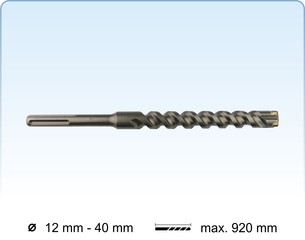
In the current range, Turbo X-Head is the main and most universal type of SDS-max drill bit. It is a modern design that handles a wide range of diameters and lengths, smooth drilling in concrete and reliable passage through reinforcement.
Turbo X-Head drill bits are manufactured with PGM certification. This confirms that the drill bit meets precisely defined dimensional tolerances and is suitable for creating anchor holes according to applicable standards. In practice, this means a more accurate hole diameter, better anchor seating and greater confidence in load-bearing and technical applications.
When Turbo X-Head is the right choice
- standard as well as demanding drilling into concrete and reinforced concrete
- larger diameters and deeper holes
- repeated work without unnecessary overloading of the machine
Today, Turbo X-Head also replaces sizes and applications that were previously covered by specialized drill bit types.
Other SDS-max drill bit types
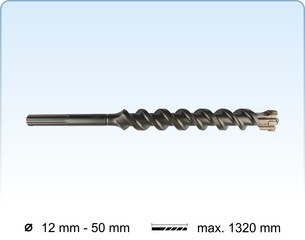
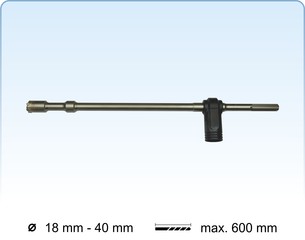
Other SDS-max drill bit types in the range play more of a complementary or marginal role. X-Cutter four-cutter drill bits and the HardRock type are currently available mainly as clearance items. Y-Cutter was originally intended for extreme diameters and lengths, which are now commonly available in the Turbo X-Head design as well. SDS-max Suction drill bits are used mainly where dust extraction is the priority, but their use is specific.
Where and how SDS-max drill bits are used in practice
SDS-max drill bits are mainly used in construction and demolition work where it is necessary to create large or deep holes in concrete, reinforced concrete and solid masonry. Typically, this involves drilling holes for heavy anchors, penetrations through structures, openings through walls and ceilings or preparing holes for technical installations in large diameters.
The SDS-max system is designed for work with high impact energy and long-term load. It offers a wide range of drill bit diameters and lengths that allow drilling where using a lighter system would be very slow or physically demanding.
In repeated drilling of larger diameters or in deep holes, the advantage of SDS-max is most noticeable. Drilling progresses smoothly, the machine works in its optimal mode and the operator is not forced to apply excessive force.
How to work with SDS-max drill bits
For drilling into concrete with the SDS-max system, powerful rotary hammers and combination hammers with pneumatic hammer action are used. They are designed for long-term load and for work with high impact energy. This system is intended for demanding drilling in hard and reinforced concrete, with larger diameters and deep holes where lighter drilling equipment is not sufficient.
The following recommendations are useful to consider if you want the work to run smoothly, safely and without unnecessary overloading of the drill bit, the machine or the operator.
Recommendations for the drilling process
Impact and its role in practice
SDS-max drill bits work with the high energy of the pneumatic hammer action of the rotary hammer. The hammer action is the key element that enables effective drilling into concrete and reinforced concrete. Drilling happens primarily due to impact energy, not due to pressure applied to the drill bit. Excessive pressure is unnecessary with SDS-max and only leads to increased strain on the machine.
Guiding the hole and feed pressure
Even with powerful SDS-max hammers, the drill bit should work through the hammer action and the machine’s own weight. Do not push on the drill bit – too much pressure slows down drilling and increases tool wear. A stable machine position and smooth guidance without jerky movements are essential.
Pilot drilling for deep holes and breakthrough holes
For deep holes or when using long drill bits, it is advisable to pre-drill the hole with a shorter drill bit of the same diameter. This improves guidance, reduces vibration and lowers the load on both the drill bit and the machine, especially when breaking through thick structures.
Removal of drilled material
During deeper drilling, the drill bit must be regularly pulled out of the hole so that drilled material can be removed. If dust is not evacuated, the drill bit chokes, friction increases and overheating occurs. This is typical especially when drilling into floors and massive concrete elements.
Drilling into reinforced concrete
When drilling into concrete, contact with reinforcement can occur and cannot always be accurately predicted in advance. Reinforcement should not be intentionally drilled through because it can affect the structural integrity – such an intervention must always be assessed individually. However, if you unexpectedly hit rebar while drilling, there is a solution to complete the job safely. For these situations, special drill bits are used exclusively for drilling through reinforcement, allowing fast and controlled drilling through steel rebar without damaging the standard concrete drill bit.
These drill bits serve as a “just in case” auxiliary tool, not for routine drilling. Currently, we offer them in the VARIANT system, and we are also preparing versions for SDS-plus and SDS-max so that this solution can be used directly with the corresponding rotary hammer.
What are the limitations of drilling with SDS-max drill bits
The SDS-max system is designed for the heaviest drilling work, yet it has its natural limits. It is not suitable for small mounting holes, fine work or drilling into soft materials, where the machine power would be unnecessarily high.
Using SDS-max makes sense mainly where larger diameters, deep holes or repeated drilling into hard and reinforced concrete are required. For standard mounting work, this system is unnecessarily heavy and harder to handle.
How is the range further structured?
The SDS-max drill bit range is structured by head design and intended use for a specific type of work, with an emphasis on the current practical role of each type:
- Turbo X-Head – the main SDS-max drill bit type for standard and demanding drilling into concrete and reinforced concrete. Manufactured with PGM certification, which guarantees precise hole dimensions for anchoring applications. Covers a wide range of diameters and lengths and replaces most previously specialized designs.
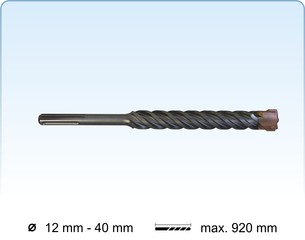
- SDS-max X-Cutter four-cutter drill bits – a proven design from the previous range, comparable in quality to other four-cutter drill bits. Now available mainly as clearance items in selected sizes.
- SDS-max HardRock drill bits – an older drill bit type from the previous range, comparable in quality to other four-cutter drill bits. Currently mostly clearance items.
- SDS-max Y-Cutter drill bits – originally offered for extreme diameters and lengths, which are now primarily covered by the Turbo X-Head type.
- SDS-max sucttion drills – a special type for drilling with dust extraction, used more marginally.
After selecting the specific drill bit type, you then choose the required diameter and length based on the specific application.
Hide Description