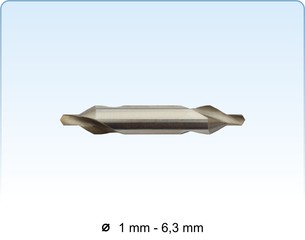
How to choose the right center drill or NC spot drill
Start by deciding what type of hole or machining operation you need.
Choose DIN 333 A center drills if you need a standardized center hole with a 60° cone, for example to support a workpiece between lathe centers. Their design, with a pilot tip followed by a cone, is intended for a different operation than NC spot drills.
NC spot drills with a 120° point angle are intended primarily for accurately starting a hole before drilling with a standard twist drill with a 118° point angle. They create a shallow guide that helps the following drill enter the material at the correct position.
Choose NC spot drills with a 90° point angle when the spotting operation should also prepare a 90° chamfer around the subsequently drilled hole. The resulting chamfer size depends on the NC spot drill diameter, the diameter of the subsequent hole and the spotting depth.
When choosing, consider:
- the required type of hole or machining operation
- the 60°, 90° or 120° point angle
- the diameter of the subsequent drill
- the required diameter of any chamfer
- the tool material: HSS, HSS-Co or solid carbide
- machine rigidity and the clamping method
- the tool and shank diameter
Where and how center drills and NC spot drills are used
DIN 333 A center drills are used in engineering production, turning shops and workshops to produce accurate center holes. A typical application is preparing a workpiece for machining between a dead center and a live center on a lathe.
NC spot drills are used on CNC machines, milling machines, jig borers and other precision machine tools. Their short, rigid design reduces tool deflection at the start of drilling and helps maintain the specified hole position.
Typical applications include:
- accurate spotting before subsequent drilling
- reducing the tendency of a twist drill to slip across the surface
- guiding the drill during precision positional drilling
- producing a center hole for turning between centers
- preparing a 90° chamfer using a 90° NC spot drill
- batch and one-off engineering production
How to work with center drills and NC spot drills
Both the workpiece and the tool must be clamped securely, and the tool axis must point precisely at the intended hole position. Center drills and NC spot drills are intended only for a short initial operation. They are not a substitute for a twist drill when drilling a hole to its full depth.
For accurate results, we recommend:
- creating only the required spotting depth
- selecting spindle speed and feed according to the workpiece and tool material
- using suitable cooling or lubrication according to the material being machined
- preventing excessive tool runout and play in the clamping system
- avoiding side loading of the tool
- regularly checking the sharpness and condition of the cutting edges
On DIN 333 A center drills, the narrow pilot section must be protected in particular against side loading and excessive feed.
Solid carbide NC spot drills require a rigid machine, secure workholding and smooth operation without shocks. Carbide is very rigid, but vibration, impact or excessive runout can damage the cutting section.
How is the range further divided?
This category is not divided into any further subcategories, but it contains four technically different product groups:
- DIN 333 A center drills for metal for standardized center holes with a 60° cone.
- 90° HSS-Co NC spot drills for accurate spotting and preparing a 90° chamfer.
- 120° HSS-Co NC spot drills for guiding standard twist drills with a 118° point angle.
- 120° TiAlN solid carbide NC spot drills for accurate spotting under rigid and stable CNC machining conditions.
The diameter is therefore not the only selection criterion. First choose the required operation, then the point angle, tool material, clamping method and specific size.
Hide